
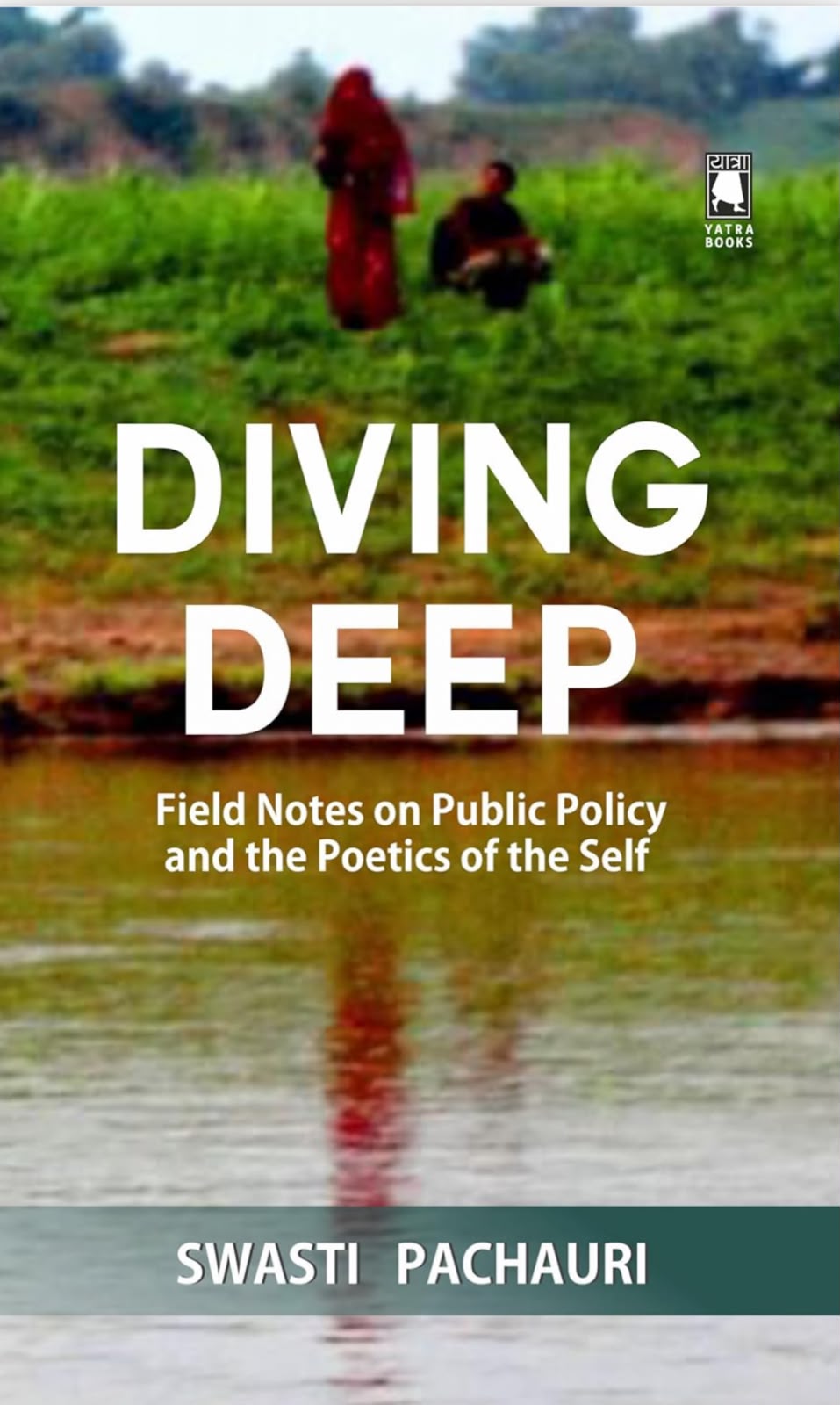
Beyond Government Files and Statistics: Cornell Academic Swasti Pachauri Explores the Human Side of Public Policy in Diving Deep
Drawing on 15 years of field experiences across India, the book examines how policies on food security, women’s livelihoods, agriculture and rural development shape everyday lives.
Diving Deep: Field Notes on Public Policy and the Poetics of the Self is a collection of the author’s field experiences and observations accumulated over the course of her career, from 2007 to 2022. Mostly written during the COVID-19 lockdown, these essays trace public policy through the lens of popular culture. Each chapter begins with a relevant poem, couplet or quotation from poets, writers and thinkers ranging from Goswami Tulsidas, Baba Bulleh Shah and Sahir Ludhianvi to Linda Tuhiwai Smith, Wendell Berry, Vandana Shiva, Marshall McLuhan and Fernando Pessoa.
The author’s experiences across several Indian districts, including Wardha, Latur and Seoni, come alive through her observations on policy issues such as food security, women’s aspirations, rural employment, the Mid-Day Meal Scheme, agriculture, farming, self-help groups, kitchen gardens, handicrafts and cultural appropriation. She also examines the idea of digital illusion and reflects on toolkits and protests, exploring themes that resonate not only in India but across several parts of the world.
Tracing her own personal journey, the author examines how public policy is deeply personal in everyday life, bringing questions of empathy, compassion and inclusivity to the forefront. References to popular culture, films and television serials such as Katha Sagar and Amravati Ki Kathayein, alongside the ideas of thinkers such as Guy Debord, Andre Gunder Frank and Immanuel Wallerstein, and writers such as Pankaj Mishra, shape these essays. Through a deeply personal lens, she explores how policy intersects with lived experiences, social relationships and the structures of power.
The book also reflects on the author’s professional journey across government fellowships, management consulting and field-based research. Drawing on her experiences of data collection and community engagement, she examines both the utility and the limitations of research methodologies such as focus group discussions, bindi mapping and transect walks. These reflections make the book particularly relevant to students of public policy, sociology, economics and public administration, as well as aspirants preparing for the civil services.
The essays invite readers to look beyond textbooks, government reports and statistics to understand how public policy shapes, and is shaped by, everyday interactions. They foreground a people-centric approach to policy, one that begins by understanding the lives, aspirations, struggles and everyday negotiations of the people public policy seeks to serve.
The essays also reflect on the larger political economy of everyday life, examining the intersections of gender, livelihoods, social inequalities, culture and power. Ultimately, Diving Deep invites readers to consider how public policy can be understood not merely as an institutional or technical exercise, but as a deeply human endeavour grounded in lived experiences, relationships and the everyday realities of society.
Dr. Swasti Pachauri is an academic and a public policy and governance expert with over 17 years of experience in academia, government, and management consulting in India. Her work focuses on women in agriculture and food systems, self-help groups (SHGs), women-led small enterprises, and craft-based livelihoods. Currently, she is a Lecturer at the Jeb E. Brooks School of Public Policy at Cornell University, Ithaca, United States teaching World Food Systems and Public Policy and Women in Leadership and Entrepreneurship in developing country contexts. Previous to this role, she has served as Deputy Director at FICCI working on public policy advocacy and as Assistant Professor of Public Policy at B.R. Ambedkar University Delhi.
Swasti holds a Ph.D. from the University of Delhi, an M.A. in Development Studies from the Tata Institute of Social Sciences, and a B.A. in Economics from the University of Delhi. She was a fellow in the Prime Minister’s Rural Development Programme, spending two years in rural Madhya Pradesh. She has also worked extensively with the local government of Delhi, gaining insights into urban livelihoods, food security, and other policy issues.
She was also a Visiting Fellow at Osgoode Hall Law School at the Institute of Feminist and Legal Studies at the University of York, Canada. She also received the presitigious David M. Einhorn Fellowship at Einhorn Centre for Community Engagement at Cornell University, USA.



Leave a Reply